This March, state forecasters confirmed that North Carolina’s revenues are running high enough to trip another round of automatic income-tax cuts, pulling the personal rate down to 3.49 percent in 2027 and 2.99 percent in 2028 (OSBM). The legislature, meanwhile, has spent much of the past year at a glacial impasse over the state budget. Both fights are arguments about how to distribute tens of billions of dollars in tax revenue. This begs the question: where did this revenue come from, and to whom does it go?
The distribution of net-contributors and net-recipients of North Carolina’s state government spending is far more uneven even than most people would guess. To approximate it, we combined county-level income tax data from the IRS’s Statistics of Income series with sales-tax collection data published by the NC Department of Revenue. The result is a close estimate, accurate to within a few percentage points, of the approximate tax contributions by county in North Carolina.
What it shows is that most of the machinery of most of North Carolina’s government - our schools, roads, courts and clinics - depends on just a small number of metropolitan counties for funding. A large swath of the state generally receives more in financial assistance from Raleigh than it contributes. And as the state’s economy concentrates ever more around Charlotte and the Triangle, that imbalance is widening.
Where the money comes from
North Carolina collected roughly $34.6 billion in General Fund revenue in the 2024–25 fiscal year. About 81 percent of it, some $28 billion, came from just two sources: the personal income tax (49 percent) and the sales tax (32 percent). These are the most direct ways in which North Carolinians fund their state government.
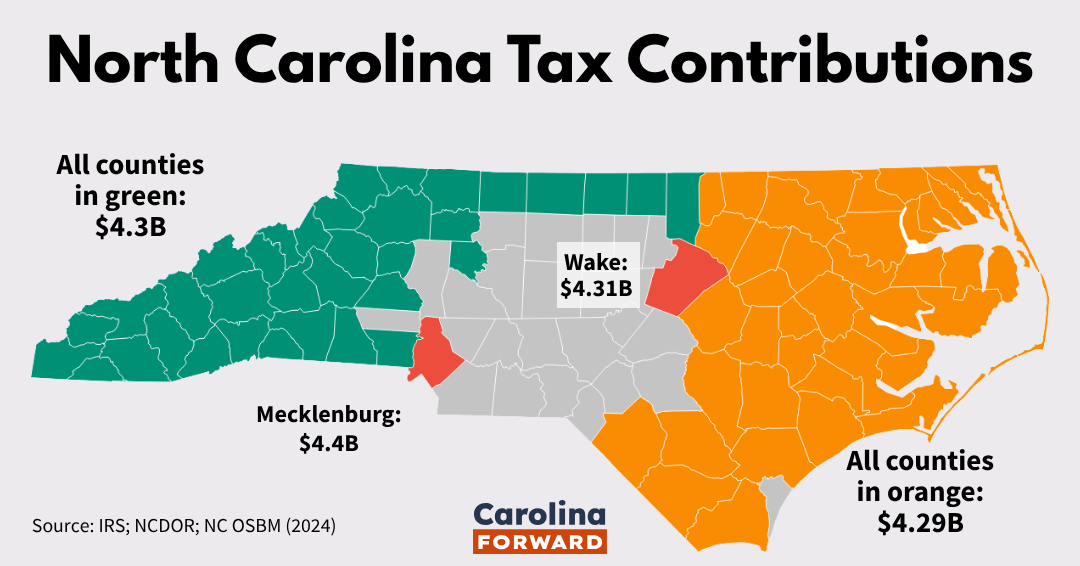
Of that $28 billion, close to a third (31%) came from just Mecklenburg and Wake counties alone. Add Guilford, Durham, Forsyth, Buncombe, and New Hanover, and those seven counties account for nearly half. Fifteen counties account for roughly two-thirds. The remaining eighty-five split what is left.
Put in plainer terms: Mecklenburg generates as much income and sales tax as the 35 counties to its west and north combined. Wake matches the 39 counties to its east — every coastal and eastern county save New Hanover. Two counties, two halves of the map.
Not simply bigger
Of course big counties pay more - after all, more people live in them. Yet that alone is not the full story.
It turns out that larger populations alone is not the only reason why metro counties contribute so much tax revenue. What the data shows is that metro counties also contribute more per resident, because the incomes earned there are higher and the commercial activity denser. The concentration is a function not only of where people live, but of where the money is.
This is just one more way in which the further concentration of the state economy around metro counties is increasing the state’s financial dependence on them.
The other side of the ledger
There is a mirror image here as well: which counties draw more from the state than they return to it?
A full accounting of every dollar flowing to and from each county would be prohibitively complex and legitimately contestable. But there is a much clearer and well-documented proxy available: public school funding.
K-12 education is the single largest category in the state budget. Nearly 40 percent of the General Fund goes to public school funding, and North Carolina, unusually among states, pays for most of it directly. Roughly 60 percent of every school district’s operating budget comes from Raleigh, rather than its home county. School funding is thus a large, easily traceable transfer from the state to each county, and a usable stand-in for the broader flow.
We compared the most recently available county school district funding (including, where applicable, municipal-level districts in the total) to that county’s total estimated tax contributions:
Measured this way, the imbalance is glaring. Forty-two of North Carolina’s 100 counties receive more in school operational funding from the state alone than their residents pay in all state taxes combined. This completely excludes all other categories of spending, like roads, Medicaid, courts, prisons, law enforcement, parks and so forth. Fold in everything else the state provides, and the roster of net recipients only grows.
The redistribution machine
The redistribution of resources from some areas to others based on need is, of course, one of the fundamental functions of government. It is arguably part of the point of being a state at all: revenue pools where the economy is densest and is spent where it is needed. A North Carolina in which every county paid exactly its own way would not be a fairer North Carolina - it would be a much poorer, harsher and crueler one.
But of particular concern is the trajectory of this balance of payments. Over the past fifteen years, much of North Carolina’s vast rural economy has steadily shrunk under the economic policies of an ideologically committed state legislature. The state’s metro economies, by contrast, have flourished. This has considerably narrowed the state’s whole tax base and made the critical state functions dependent on the continued prosperity of just a few counties - and given the state much less cushion if that prosperity ever stalls.
Of course, being home to prosperous metropolitan areas that are growing rapidly is an enviable blessing to North Carolina, and one which many states envy. Those tax revenue engines make possible investments across our entire state. Yet at the same time, a tax base that is more and more reliant on just two counties is precarious by nature. A more durable answer is to widen the base: to build economies beyond big metros that can stand more squarely on their own. After all, the question is not whether another recession will eventually hit, but rather when. To the extent that North Carolina’s state government depends on the revenue engines of just two counties to pay the bills, it is highly vulnerable to significant financial risk.